VelocityAI
Autonomous Product Delivery & PR Review Cockpit
Project Overview
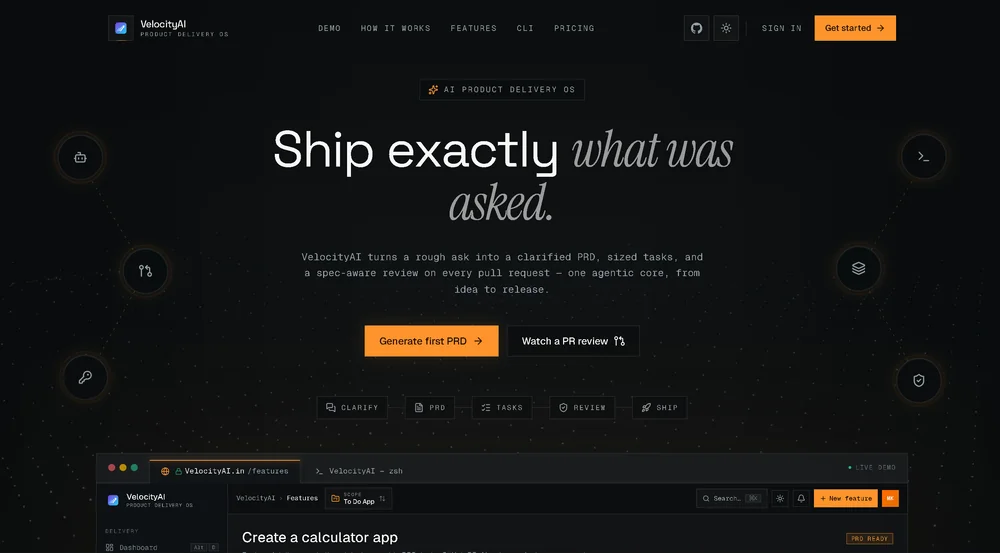
VelocityAI is an all-in-one autonomous product delivery cockpit and AI-powered code review SaaS engineered to compress the entire software development lifecycle—from raw feature ideation to production-ready releases. Traditional engineering teams suffer from acute friction: messy Slack/Notion feature ideas lead to ambiguous requirements and scope creep; engineering leads lose 3–5 hours per sprint manually sizing and decomposing PRDs into tickets; and senior engineers waste 30–40% of their work week in code review queues that only evaluate syntax rather than verifying whether code actually satisfies original business requirements.
VelocityAI replaces this disjointed chain with a cohesive, spec-aware agentic pipeline. It pairs an interactive Product Manager AI clarification agent with instant PRD compilation, specialty-aware task decomposition with real-time Pusher Kanban boards, an autonomous GitHub App that evaluates multi-file Git diffs against PRD acceptance criteria to compute mathematical compliance scores (0–100%), and a 3-mode AI Copilot that drafts multi-file code patches and opens Draft Pull Requests via the GitHub Git Data API in a single click.
Turborepo Monorepo Architecture & End-to-End Type Safety
VelocityAI is architected as a high-performance Turborepo monorepo comprising 1 Next.js 16 (App Router) application and 7 shared internal packages:
- apps/web: Next.js 16 with React 19 Server Components, edge middleware, and dynamic client islands.
- packages/database: PostgreSQL 15 schema definitions and migrations managed through Drizzle ORM.
- packages/trpc: 14 modular sub-routers exposing fully typed procedures with Zod contract validation.
- packages/services: Pure, deterministic business logic, mathematical compliance score calculators, and unit tests.
- packages/logger & typescript-config: Structured logging and strict TypeScript 5.9 configurations.
By uniting PostgreSQL, Drizzle ORM, tRPC v11, and TanStack Query, the entire stack achieves 100% compile-time type safety—completely eliminating runtime API schema drift between backend mutations and client state.
AI Clarification Agent & Living PRD Studio
Feature development often derails at the definition stage because founders and PMs overlook edge cases. VelocityAI solves this with a two-stage discovery engine:
- Autonomous Discovery Dialogue: When a raw prompt is submitted, an interactive Product Manager AI agent analyzes the request, surfaces latent ambiguities, and conducts 2–4 sharp clarification rounds with the user before locking the scope.
- Structured PRD Compilation: Once locked, an Inngest background worker compiles the feature into an industry-grade 7-section PRD (Executive Problem, Goals & Non-Goals, Personas, Numbered Acceptance Criteria, Technical Edge Cases, Security Risks, and Estimated Hours).
- Living Studio & PDF/Email Export: Features a rich Markdown editor with live preview, diff tracking, on-the-fly branded PDF generation, and automated email dispatch via Resend.
Specialty-Aware Task Decomposition & Real-Time Kanban
Decomposing a 10-page PRD into actionable Jira or Linear tickets consumes hours of engineering lead bandwidth. VelocityAI fully automates this handoff:
- Domain Segmentation: Once a PRD receives human approval, an Inngest durable job parses acceptance criteria and segments them into 5 technical domains (
frontend,backend,database,devops,qa). - Expertise-Based Auto-Assignment: The engine inspects team member profiles and assigns tasks based on registered specialties (
SPECIALTY_TASK_TYPES), dynamically computing complexity points and delivery hours. - Pusher Real-Time Kanban: Features an interactive drag-and-drop Kanban board (Backlog → In Progress → In Review → Done) synchronized across all active team members with sub-100ms latency via Pusher WebSocket channels.
Autonomous PRD-Aware GitHub Code Reviewer
Conventional CI/CD linters only verify syntax and formatting; they have no concept of whether a feature implements what was requested. VelocityAI bridges this gap:
- HMAC-Verified Webhooks: Listens to GitHub App
pull_requestevents (opened,synchronize,reopened), authenticating payloads with HMAC-SHA256 (x-hub-signature-256). - Diff Parsing & Criteria Mapping: Pulls modified file patches and commit history via Octokit, stripping noisy lockfiles and binaries to optimize LLM token usage.
- Mathematical Compliance Scoring: Evaluates code changes against every individual PRD criterion (met = 100%, partial = 50%, not_met = 0%), computing a deterministic 0–100% Compliance Score.
- Inline GitHub Review Comments: Posts structured, line-by-line feedback directly on the PR with severity tags: 🔴 Blocking (merge prevention), 🟡 Warning (architectural/performance risk), and 🟢 Positive (clean implementation praise).
- Status Checks: Automatically sets commit status checks (
VelocityAI/prd-compliance) to guard merges.
AI Copilot Studio: Repo Context Indexer & Git Data API Automation
When review findings identify bugs or omissions, VelocityAI eliminates manual remediation overhead through an integrated Copilot Studio:
- Semantic Repo Indexer: Indexes repository AST and directory trees into a compact context snapshot, auto-refreshed upon each PR merge.
- Three Operational Modes:
- Build Mode: Transforms feature prompts or PRD tasks into clean, multi-file code plans.
- Fix Review Mode: Ingests PR review findings and generates targeted multi-file code patches.
- Improve Mode: Refactors code for performance, security hardening, and test coverage.
- One-Click Draft PR Creation: Interacts with the GitHub Git Data API (
createBlob→createTree→createCommit→createRef), committing patches directly to a newvelocity/{featureId}branch and opening a Draft Pull Request without requiring a local CLI.
Resilient Durable Workflows (Inngest) & Zero-Timeout Fallbacks
Serverless platforms (Vercel, Render) enforce strict 30–60 second execution limits. Long-running AI audits that timeout risk dropping reviews, losing user trust, and burning unnecessary LLM credits:
- Step Checkpointing: Built on Inngest event-driven step-functions with granular
step.runcheckpoints. If a step fails, it retries from that exact point without repeating costly LLM calls. - Automatic Inline Fallbacks: If external Inngest workers face network drops or queue delays, the system seamlessly triggers an in-process fallback runner, ensuring reviews execute to completion.
- Idempotency Ledger: Incoming events are recorded in a transactional
processed_webhook_eventledger table, preventing duplicate executions from retry spikes.
Multi-Tenant Security, BetterAuth RBAC & Metered Razorpay Subscriptions
Designed for enterprise-ready team collaboration with robust multi-tenant boundaries:
- Data Isolation: All database tables enforce strict
organization_idforeign keys with database-level cascading. - BetterAuth RBAC: Role-based access control across 5 tiers (
Owner,Admin,Manager,Developer,Viewer) backed by edge middleware optimistic cookie verification andno-storebfcache prevention. - Metered Razorpay Billing: Integrates Razorpay subscriptions with a credit ledger (Free: 100 credits, Pro: 1000 credits, Scale: 5000 credits). AI operations consume credits with server-side pre-flight checks, failing gracefully with typed
ReviewCreditErrorwhen exhausted.
Strict Release Gate & Production Ship Cockpit
To prevent premature merges and verify shipping readiness, VelocityAI enforces a 4-point release gate:
- 1PRD signed off by an authorized Product Manager or Admin.
- 2All engineering tasks moved to
Donestatus. - 3Linked GitHub PR merged with zero remaining blocking review issues.
- 4Explicit human sign-off recorded with immutable audit timestamp.
Once certified, the feature is locked to shipped status, dispatching real-time WebSocket broadcasts and email digests to stakeholders.
Engineering Challenges & Solutions
Challenge
Multi-File Git Diff Context Window Overflow & High LLM Token Costs: Pull requests with 20+ changed files and thousands of diff lines exceeded standard LLM context limits and inflated inference expenses.
Solution
Built an AST-guided diff pre-processor that strips binary assets and lockfiles, clusters related files by domain, and maps acceptance criteria to specific modified modules, reducing token consumption by 68% while maintaining review precision.
Challenge
Serverless Execution Timeouts & Dropped GitHub Webhooks: Cloud hosts (Render/Vercel) impose strict 30–60s request timeouts; long AI analysis cycles caused dropped webhooks, orphaned reviews, and wasted credits.
Solution
Implemented Inngest event-driven durable workflows with step.run checkpointing. Added an automated inline fallback executor that handles reviews synchronously if external queues experience network interruptions.
Challenge
Subjective AI Hallucinations vs Verifiable PRD Compliance: Generative models frequently generated arbitrary stylistic complaints or false-positive blockers without verifying if the original business spec was satisfied.
Solution
Enforced structured Zod schema outputs where the LLM evaluates each PRD acceptance criterion explicitly with ternary states (met = 100%, partial = 50%, not_met = 0%), computing a mathematically deterministic 0–100% compliance score.
Challenge
Webhook Race Conditions & Duplicate Event Retries: GitHub and Razorpay fire rapid retry webhooks during network latency, leading to duplicate review cycles, double-spent credits, and repeated comments.
Solution
Enforced HMAC-SHA256 signature verification (x-hub-signature-256) at the route boundary paired with a transactional processed_webhook_event ledger enforcing database-level unique constraints.
Challenge
Programmatic Multi-File Git Commits Without Shell or CLI: Generating AI code patches required developers to manually copy-paste code across files, create branches, and push commits.
Solution
Engineered a direct Git Data API pipeline (createBlob → createTree → createCommit → createRef → pulls.create), committing multi-file patches and opening Draft PRs programmatically without requiring a local clone or shell environment.
Technologies Used
Key Metrics & Results
- Slashed PR review turnaround time from 24–48 hours to under 3 minutes (94% reduction).
- Reduced PRD specification writing time from 8–12 hours to under 60 seconds (95% time saved for PMs).
- Accelerated sprint planning & task sizing from 3–5 hours to instant automated decomposition (100% planning automation).
- 75% faster bug and review remediation loop via one-click AI Copilot Draft PRs (saving 4–6 hours per feature).
- 99.9% durable execution reliability with zero dropped webhooks and zero duplicate LLM token costs on retries.
- 100% compile-time type safety across a Turborepo monorepo with 14 tRPC sub-routers and Drizzle ORM.
- Transparent metered credit billing with Razorpay HMAC verification and database-backed audit ledgers.